Guest Post
Status Update: ALife and Japan
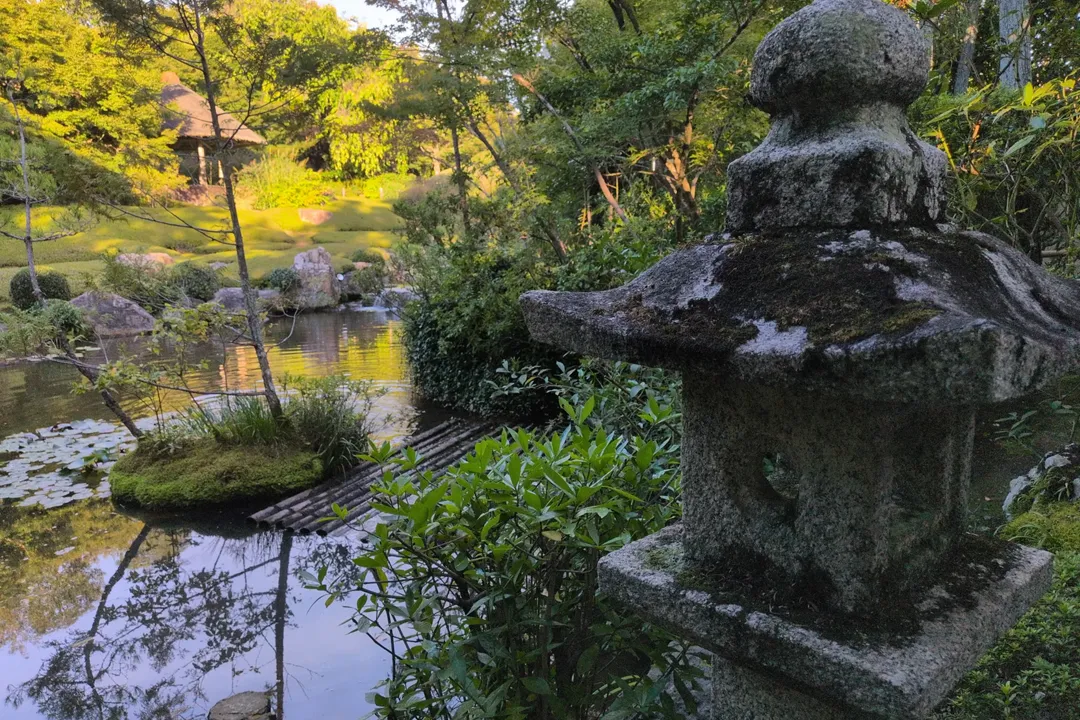

This post was originally published on Nate's blog, on October 25, 2025.
(This post’s image is a photo I took of the gardens at Myoshinji Temple. In the foreground on the right is a stone lantern with dark green moss clinging to it. To the left is a pond with a small island, a bamboo raft, and some lily pads, reflecting the blue sky above. In the distance, the sun colors a mossy hillside, some trees, and a small building in golden light.)
I do love traveling the world. It’s fascinating to see different ways of life, both in terms of cultures and ecosystems. It helps to show just how much of life as we know it is sorta arbitrary, and could easily have turned out different. It also shows the universals in life and human nature, the themes that come through again and again wherever you go. There’s so much unique beauty in every place that is never fully captured in photos and stories. You have to see it yourself. That said, busy airports and 12+ hour flights are hell on earth. The airline industry has become so unreliable lately I feel like pain is inevitable in a trip like this. For instance, we got delayed by half a day or more on both legs of our trip. So, while I loved being there, getting there and back was awful. I think it was worth it, but the difficulty of travel is definitely a limiting factor for me.
Since we arrived late, I had to hit the conference first thing the next morning, heavily jet-lagged. It was an incredibly intense week jam packed with research talks, demos, panel conversations, and more. Unfortunately the event was plagued with technical difficulties and logistical problems, but somehow the team pulled off a very successful conference nonetheless. So, a big kudos to them! I really enjoyed many of the talks, and my presentation was a big hit. I received many good questions and compliments, and even won Best Student Paper, which was a shock! I got to see many great presentations from peers I know, total strangers, and big names in the field who I admire and respect. Also plenty I didn’t like, but I suppose that’s part of the fun.
I say that because ALife as a field is incredibly diverse. Really, it’s an umbrella for all kinds of research. The unifying theme is computational work inspired by biology, or “life as it could be” as the catch phrase goes. But, that includes people doing math to propose universal laws of biology across the universe. It includes people who claim to have spontaneously generated true life in a computer program. It includes companies selling lifelike robots, designed using methods that are not lifelike at all. It includes people making abstract models of biological systems to better understand life in the real world. And it includes artists using generative AI for collaborative live DJ performances. This is frustrating, because there are parts that I care about deeply and feel are done really well, and other parts that seem silly, or that I actively dislike and wish were done differently or not at all. I feel like the sheer diversity is much of the point, though, and I appreciate the chaotic mess of it all. Somehow, that feels appropriate for a group studying “life as it could be.”
I feel like I belong in the ALife community. I still don’t know much about it, and I can already see many problems and difficulties there. But this is a place where work like mine is the norm, fully accepted, and appreciated as worthy and interesting. This is a community that “gets it.” I’ve already found a lot of like-minded people, too. I met some lovely folks from Emily Dolson’s lab at MSU, who I might potentially collaborate with. I had some great conversations and arguments. I also started to engage with the Emerging Researchers in ALife community, and found multiple folks pursuing ideas very close to my own, many of whom are working alone with little guidance, much as I was before I took the leap to get my PhD. I’m very excited to find my peers, and feel compelled to help out and foster a community where these ideas can thrive, develop, and maybe find a larger audience.
Although I tried to drink deeply of the conference, I also made plenty of time to escape and have some moments on my own and with my wife to explore Kyoto, which is an amazing place. We had so many delicious meals. Sushi. Ramen. Udon. Tempura. Izekaya. Shabu shabu. Obanzai. Kushiaki. The quality was always very high, and there were so many delightful local specialties that are hard to find in the USA (especially Vermont 🙄). The city itself is beautiful, easy to navigate, and clean. I think perhaps the most striking thing is how often I’d be walking down a perfectly normal looking modern street and then suddenly I’d run into a historic temple or shrine, right in the middle of everything. These could be quite lovely, and often included gardens of stunning beauty. I love how the practice of Buddhism and Shintoism in Japan is so bound up with natural beauty and quiet contemplation. I find Christian cathedrals quite beautiful and peaceful, too, but they feel so much more constructed and enclosed. They remind me of man’s “triumph” over nature, while a Zen garden makes me feel like a guest on God’s planet.
Unfortunately enjoying the natural beauty and historic sites was a little challenging, just because of all the tourists! Kyoto is a very popular destination, and the notable sites are just swarming with people for most of the day. My wife made a point of setting out very early in order to beat the crowds, and seeking out some of the less well known venues. I think that worked out very well for us. We got some private, quiet moments that were truly magical. And speaking of sites that are under-appreciated, I thought the Kyoto Museum of Crafts and Design was a real highlight of the trip! It’s very small, but they have some wonderful exhibits of traditional Japanese crafts and their modern evolution. What makes this place really special, though, is the emphasis on teaching how things are made! There are hands-on exhibits, examples of objects at various stages of their construction, and videos showing the artisans and how they work. This gave me a much deeper appreciation, both for the artworks, and for the amazing traditions that produced them.
All in all, it was an extraordinary trip. I learned a lot, had some great personal interactions, had some great experiences, and overall had a very good time. I feel lucky that I got to go, and I hope to attend many more conferences like this in the future, including venues besides ALife. Most notably, I can’t wait to go to a conference on evolutionary computation, like GECCO. But I see that I have a place in the ALife community, and I suspect it will become an important place for me going forward.
They haven’t yet published the individual papers from the conference or the presentation videos. I’ll share those when they’re ready. But the full proceedings (including my paper) are now available online, for folks who want to dig in, or are just curious to see the full diversity of what was presented.